The Boat Guide A working manual, not a brand ranking
You argued $900 off the price.
Then you handed back four times that.
A boat costs you eleven lines a year, and most owners can only name three. The other eight are where the money actually goes — and nobody writes them down. 140 numbered methods for buying smarter, owning cheaper, and selling higher than the slip next to you.
Instant download · Yours forever

“The money is almost never lost where they think it will be.”
— Before You Begin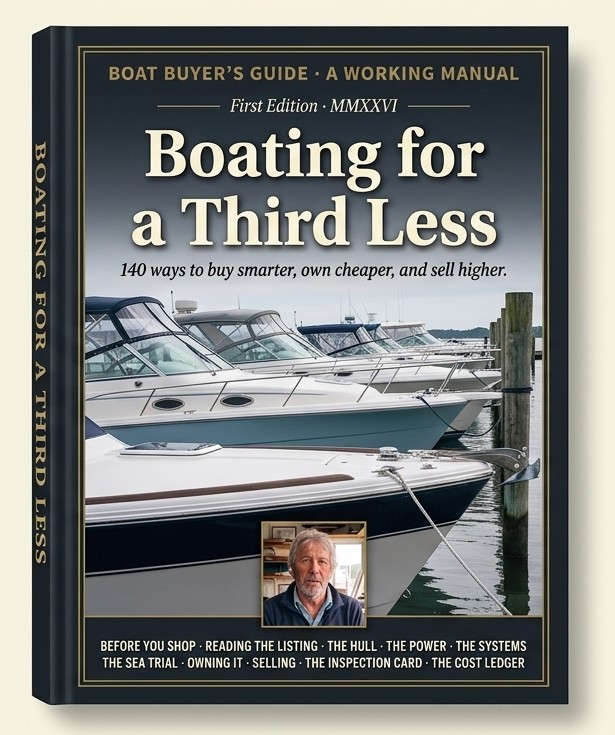
Section I · The Manual
Not the sticker. The other three quarters.
People spend six weeks agonising over the asking price, argue nine hundred dollars out of a seller on a Saturday morning, and then hand back four times that over the following twelve months without ever noticing.
They pay for a slip in the wrong month. They insure the boat on the wrong basis. They run the wrong propeller for three seasons and burn fuel paying for it. They let a fifteen-dollar part fail into a two-thousand-dollar repair. Then, four years later, they sell into the wrong season, to the wrong buyer, with a folder full of nothing, and lose again on the way out.
“A third less is what comes off the total cost of getting into a boat, keeping it, and getting back out of it. It is arithmetic, and I have shown you the arithmetic.”
On a twenty-five thousand dollar used boat, the eleven annual lines typically total somewhere between $2,200 and $5,800 a year before the boat has moved an inch. That spread — same boat, same town, same boating — is thirty-six hundred dollars a year. It is not luck. It is eight decisions, and every one of them is written down in Part Seven.
Section II · The Difference
Same boat. Same town. Different year.
Every line on the right is a numbered method in this manual, with the reason and the arithmetic written out.
Section III · What's Inside
136 pages. 140 numbered methods.
Eight parts that follow the shape of the thing itself: deciding, shopping, inspecting, testing, negotiating, paying, owning, and selling. Every method reads in three minutes and can be acted on the same day.
Every method closes with a marked line
Four of them, and they mean exactly what they say.
- SAVESMoney that stays in your account, per year or per event, when you do the thing.
- COSTSWhat you have to spend first — with the payback stated in the same breath.
- CHECKA physical thing to look at, touch, lift, smell or measure, and the result that means trouble.
- WALK AWAYFifteen of them. Thank the seller, get in the truck, drive home.
Start Here — before you read another page
Three opening chapters, then three fixes to do this weekend. About four hours; two of them cost nothing.
- Before You BeginWhat the title actually promises, and how the arithmetic is meant to be read.
- How To Use This BookHow a method is built — the trouble, the method, the numbers, and where it stops.
- The First WeekendPrice the year on eleven lines · read the hours against the calendar · find out what storage really costs within twenty miles of you.
The Eight Parts — 140 methods, numbered straight through
Cross-referenced by number, because the work cross-references itself.
- Part OneBefore You ShopCount the days you will actually use it · the twenty-five percent rule on weight · match the truck you already own · outboard, sterndrive or inboard over ten years · the two-foot-itis tax · the Rule of Two.Methods 1–16
- Part TwoReading The ListingGrade the photographs before the words · the five questions that end a bad listing in one message · read the hull identification number from a photo · find the boats that are not listed.17–32
- Part ThreeThe Hull And The StructureArrive with the right nine things · sound the deck with a plastic mallet · test the transom two ways · the moisture meter as a map, not a verdict · find the repairs somebody hoped you would not notice.33–52
- Part FourThe PowerVerify the hour meter three ways · watch the first ten seconds of a cold start · pull the lower unit oil and look at it · read compression as a spread, not a number.53–74
- Part FiveSystems, Trailer, And PaperTest every pump with water · check the bearings, because this is what strands people · read the tires by their date, not their tread · verify the trailer's own paperwork · the rain test on a cabin boat.75–94
- Part SixThe Sea Trial And The OfferRun the sea trial properly · make survey and trial a written condition · negotiate from the written list, not from a feeling · the three things sellers actually want · close on paper, with everything named.95–110
- Part SevenOwning It For LessShop storage every single year · keep the impeller on a calendar, not on hours · run at the speed that costs the least · buy fuel off the water · re-shop insurance every two years · run the ledger every December.111–128
- Part EightSelling HigherStart selling in January for a spring sale · sell the folder, not just the boat · photograph it properly, which takes one morning · price against sold boats, then hold the line · close the sale safely.129–140
And three workbook appendices at the back
Instant download · Yours forever
Section IV · Reader Results
From the dock
“I wrote out the eleven lines on a legal pad like he says and found four hundred dollars a year in storage inside two phone calls. Same boat, eleven miles further.”
Dale R. · Lake Norman, North Carolina“Divided the hours by the age at the second boat I looked at and the number made no sense at all. Asked the questions in Part Four and the seller stopped answering. That is a walk-away I would have driven right past.”
Mike H. · Traverse City, Michigan“Sold mine in April off the January checklist with the folder made up the way he describes. Full asking, first weekend, and the buyer said the folder was why.”
Ray P. · Sarasota, Florida
Section V · About
The Boat Guide
“I have watched a lot of people buy a lot of boats, and the money is almost never lost where they think it will be.”
You will notice quickly that I do not name brands. That is deliberate, and it is not timidity. A brand ranking is worth something for about eighteen months. Factories change hands, a good line gets cost-engineered by new owners, a middling line hires a good engineer and quietly becomes excellent. Meanwhile the identical hull comes out of the identical mold wearing three different badges at three different prices.
So instead I have written down how the judging is done. How to read a hull with your hand and a plastic mallet. How to read an engine's whole life in twenty minutes, whatever is cast into the cowling. How to read a trailer, a title, a bilge, a service folder, and a seller. Learn that and you will never again need anyone, including me, to tell you which badge is good this year.
The dedication at the front of the book says it plainly: for everyone who has stood on a dock in the rain with a flashlight, wondering whether the boat in front of them was a bargain or a bill.
Section VI · Order
The First Edition
Everything below is in the file you download. Nothing else to buy.
Boating for a Third Less
- 140 numbered methods across eight parts — before you shop, through the sea trial, to the day it leaves.
- Three opening chapters, including The First Weekend — three fixes, about four hours, two of them free.
- Every method marked SAVES, COSTS, CHECK or WALK AWAY, with real 2026 dollar figures attached.
- Appendix A — The Dockside Inspection Card, the whole inspection on paper you can carry.
- Appendix B — The Annual Cost Ledger, the eleven lines laid out to fill in.
- Appendix C — The Paper Pack, everything that must exist before money moves.
- PDF, 136 pages — read it on a phone at the dock, or print the inspection card for the truck.
$47$27
Get the Manual →Instant download · Yours forever
Visa · Mastercard · Amex · PayPal — secure checkout by Gumroad
Section VII · Questions
Before you order
Is this a marine survey, or a substitute for one?
No, and the book says so on its own copyright page. This is a general educational manual for the private buyer working with a flashlight and a notepad. Nothing in it replaces an inspection by an accredited marine surveyor or a diagnosis by a qualified marine technician.
What it does is get you to the surveyor with the right boat. Method 96 tells you plainly when to hire one, and Part Three is written so that the boats worth paying a surveyor to look at are the only ones that get that far.
Your videos are free — why buy this?
A video shows you one boat. The manual gives you the method, numbered and cross-referenced, so it works on the next boat and the one after that — including boats nobody has ever reviewed.
And a good deal of this does not fit in a video at all: the eleven-line ledger, the fifteen walk-aways, the dockside inspection card, and the whole of Part Seven, which is where most of the money actually is.
Does it name brands, models, or dealers?
None of the three, and none are ranked. A badge ranking starts rotting the day it is printed, and it teaches you nothing you can use on the next boat.
What is written down instead is how the judging is done, so the methods work on any hull and any engine regardless of the name on the side. Nothing in the book is a paid placement and no company has reviewed, sponsored or approved any part of it.
Why only $27?
Because it is a file, and sending it to one more person costs nothing. A printed manual of this size runs three or four times as much, and most of that is paper, shipping and shelf space.
$27 is the launch price against $47. It is less than a half tank of fuel, and the first fix in the book — ninety minutes with a sheet of paper — is aimed at the largest single number in the whole manual.
What format is it, and how do I get it?
A PDF, 136 pages, delivered within about a minute of ordering. Read it on a phone, a tablet or a computer, and print the pages you want in your hand — most people print Appendix A and keep it in the truck.
I already own a boat. Is this only for buyers?
Part Seven is eighteen methods on owning it for less, and it is the part current owners get the most out of — storage, insurance, winterizing, the impeller calendar, the speed that costs the least, and buying fuel off the water. Part Eight is twelve more on selling higher.
The First Weekend is written to work whether you are shopping, already own one, or are about to sell.
Are the dollar figures real?
They are 2026 scale markers, not quotes. They are printed so you can tell a $200 problem from a $9,000 problem while you are standing in front of it.
Parts, labor rates, slip fees, insurance, fuel and boat values move constantly and vary enormously by region. Every number in the book should be re-checked against a current local quote before you rely on it.